


Bibliographic Review of Friction Stir Welding of Al–B4C Metal Matrix Composites
L.Dubourg1
Stirweld
1 Corresponding author: laurent.dubourg@stirweld.com
1 – Introduction
Aluminum–boron carbide (Al–B4C) metal matrix composites (MMCs) are lightweight materials offering high specific strength, stiffness, and high neutron-absorbing capability due to their high boron content. However, their practical use in aerospace and nuclear applications has been limited by the difficulty of joining these ceramic-reinforced aluminum materials using conventional fusion welding. Fusion welding often leads to the decomposition of B4C, formation of brittle intermetallic phases, and weld defects such as porosity and low joint efficiency. This bibliographic review examines friction stir welding (FSW), a solid-state joining process well-suited for aluminum alloys. Key findings include: (1) FSW avoids formation of deleterious Al–B–C compounds by keeping the process below the melting point, preserving B4C particles and producing joints with near-parent metal strength; (2) appropriate FSW process parameters such as tool design, rotational and travel speeds, and forging force critically influence particle distribution and weld integrity; (3) FSW joints exhibit refined microstructures, uniform B4C particle dispersion, and minimal defects, leading to high weld quality; (4) the mechanical properties of FSWed Al– B4C joints are high –achieving 90–100% of base metal tensile strength, or even exceeding it in some cases – with improved ductility relative to fusion welds. FSW emerges as an effective joining method for Al– B4C composites, enabling high-strength welds without compromising the composite’s microstructural integrity. Potential research directions include optimizing FSW tool materials to mitigate tool wear on abrasive B4C, and further exploring parameter windows for improved mechanical performance.
2 – Problem Statement
Welding aluminum matrix composites reinforced with B4C presents challenges. This section outlines the background and difficulties of Al– B4C MMCs (particularly with fusion welding), and introduces friction stir welding.
2.1 Introduction to Al-B4C MMCs
Metal matrix composites consist of a ductile metal (e.g. aluminum) reinforced with hard ceramic particles. In the case of Al– B4C systems, boron carbide (B4C) particles are embedded in an aluminum alloy matrix. These composites are valued for their high specific stiffness, hardness, and wear resistance, combining aluminum’s light weight with high B4C hardness. The boron content of B4C also imparts a high neutron absorption cross-section, making Al–B4C MMCs attractive for nuclear applications (e.g. neutron shielding and waste storage casks). Other potential applications include lightweight armor and aerospace components requiring high wear resistance and low density.
However, incorporating such ceramics introduces challenges. B4C particles are brittle and have a thermal expansion coefficient drastically different from aluminum. These differences, plus the high hardness of BC, complicate conventional processing and joining of Al– B4C components. Mechanical joining or adhesives are sometimes used but may not meet structural requirements for high-load or hermetic joints.
2.2 Issues with Fusion Welding Al-B4C MMCs
Traditional fusion welding processes (e.g. arc welding, laser welding) tend to produce poor quality joints in Al– B4C composites. The high temperatures involved melt the aluminum matrix and chemically attack or dissolve the B4C reinforcements, causing undesirable reactions. For example, during laser welding of AA1100 aluminum with 16% B4C, most B4C particles decomposed, forming brittle intermetallic AlB and AlBC phases as needle-like precipitates in the weld metal [Guo 2012-2].
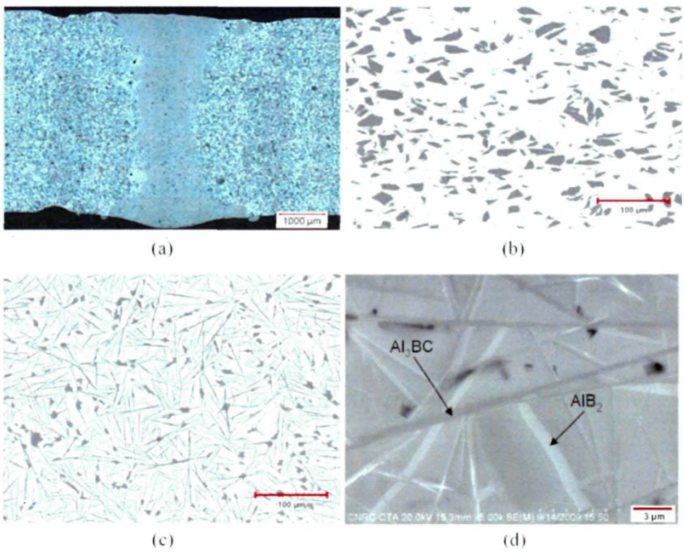
Figure 1 – typical microstructures of: (a) macro-view of the laser joint, (b) base material, (c) weld zone under OM, and (d) weld zone under SEM [Guo 2012-2].
These brittle phases severely degrade joint strength and ductility. Indeed, the tensile strength (UTS) of a laser-welded AA1100–B4C composite was 63% of the base metal UTS due to the presence of these phases. Fusion welds in Al– B4C composites also suffer from porosities (gas entrapment during solidification) and high residual stresses caused by thermal contraction. Optimizing fusion parameters (e.g. increasing laser power from 2 to 4 kW and travel speed from 1 to 2.5 m/min in order to reduce the welding time) does little to eliminate these needle-like reaction products and porosity. Adding alloying elements to mitigate the chimical reactions (e.g. titanium foil interlayers) have shown limited improvements; for example, adding a Ti interlayer (thickness of 150 µm) on carbide particles in laser welding of AA1100– B4C raised the joint efficiency to 75%, by reducing the amount and size of the brittle phases.
Given these limitations of fusion welding, solid-state processes were investigated for joining Al– B4C composites. The primary goal was to eliminate melting of the aluminum matrix during welding, thereby preserving the integrity of B4C particles and preventing the formation of reaction products.
2.3 Friction Stir Welding (FSW)
Friction stir welding (FSW) is a relatively new solid-state joining process invented at The Welding Institute (UK) in 1995. It has been applied to aluminum alloys that are difficult to weld by fusion (series 2xxx and 7xxx). In FSW, a non-consumable rotating tool with a specially designed pin and shoulder is plunged into the material and traversed along the joint line (in a butt-joining configuration) under significant downward force (about 1,5 kN per millimeter of welding penetration). Friction between the tool shoulder and pin and the workpiece, combined with high plastic deformation, generates localized heating that softens the material around the tool without melting it. The tool rotation and translation stir the softened metal from the leading side of the pin to its retreating side, forging a solid-state bond as the material cools and consolidates behind the advancing tool. [Mishra 2005]
A major advantage of FSW for Al– B4C MMCs is that no melting occurs, thereby avoiding the formation of Al–B–C intermetallic phases and porosity observed in fusion welds. The solid-state nature of FSW allows B4C particles to remain largely intact (though in refined form) within the stir zone, maintaining the composite reinforcement benefit. Typical FSW generates peak temperatures around 70–90% of the base alloy melting point, which is sufficient to plastically flow aluminum but too low to dissolve or react B4C significantly. The mechanical mixing during FSW tends to break up clusters of B4C and distribute the particles more uniformly in the weld zone. The result is a sound joint with fine-grained microstructure and well-dispersed reinforcement, yielding high strength and good ductility as detailed in later sections. [Far 2018]
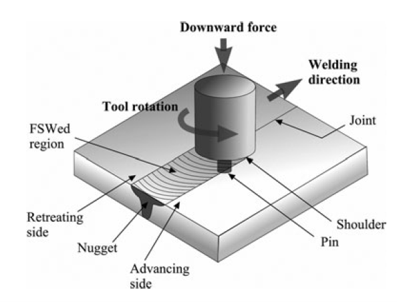
Figure 2 – Schematic of the friction stir welding process.
3 – FSW parameters of Al-B4C MMCs
Process parameters such as tool design, tool material, rotation speed, traverse speed, and forging force influence the outcome of friction stir welding in Al– B4C composites. This section compiles data from multiple studies on FSW of Al– B4C MMCs to highlight typical parameters used and their effects.
Several research works have investigated FSW on Al– B4C MMCs of varying compositions and production routes (e.g., powder metallurgy, casting, accumulative roll bonding). Table 1 summarizes key FSW parameter sets from representative studies, including alloy type, B4C fraction, plate thickness, tool material/profile, rotational speed, travel speed and axial force.
| References | Composition | Plate Thickness | Plate Thickness | Rotation Speed | Travel Speed | Axial Force |
| [Guo 2012-2] | AA1100 + 16-30% B4C | 5 mm | Tungsten carbide–Co tool (vs. H13 steel tested) | 1200 rpm* | 100-275 mm/min | n/r (force control) |
| [Far 2018] | Pure Al + 2 vol% B4C | 2 mm | H13 tool steel (Cylindrical, Sq., Triangular pins) | 560-900 rpm (optimum ~710 rpm) | 100-300 mm/min (optimum : 300 mm/min) | n/r |
| [Ali 2021] | AA6061 + (10% SiC & 3% B4C) | 6 mm | HSS (tapered cylindrical pin) | 1200 rpm | 60 mm/min | 10 kN* |
| [Man 2025] | AA6061 + 10% B4C | 6 mm* | H13 tool steel (Square vs threaded pins) | 700-1400 rpm | 40-63 mm/min | n/r |
Table 1 – Representative FSW parameter ranges for joining aluminum-boron carbide metal matrix composites (n/r = not reported)
Accéder à l’article scientifique complet
Vous venez de lire un extrait de ce document scientifique sur le soudage par friction-malaxage. Pour accéder à l’intégralité du document au format PDF, veuillez remplir le formulaire ci-dessous.
Section snippets
4 – Weld Quality of FSW Al-B4C MMCs
This section examines the weld microstructure (particle distribution, intermetallic phases), integrity (defects), and addresses the issue of tool wear…
5- Mechanical Properties of FSW Al-B4C Joints
This section covers hardness profiles, tensile strength and joint efficiency of FSW joints, along with comparisons to as-cast or base materials and fusion-welded counterparts…
6 – Conclusions
Friction stir welding is an enabling technology for joining aluminum–boron carbide composites. By avoiding melting, FSW solves the problems of fusion welding, preventing B4C dissolution and associated porosity and achieving weld efficiencies up to 100%. The microstructure of FSW joints in Al– B4C MMCs is characterized by refined aluminum grains and a uniform distribution of B4C particles in the stir zone, with no new brittle phases. Optimized FSW parameters produce sound welds with no cracks or voids, though controlling tool wear remains a practical consideration due to the abrasive nature of B4C particles…
